Day 1: Tashkent
Upon arrival in Tashkent, your driver will meet you and take you to the hotel. Overnight at the hotel.
Day 2: Tashkent - Nukus - Muynak – Nukus
In the morning transfer to the airport for the flight to Nukus (flight time: 2 hours 45 minutes). Upon arrival in Nukus the sightseeing program begins.
You'll take a trip to the town of Muynak. On the way you'll see the ancient complex Mizdahkan - a large necropolis with numerous medieval mausoleums.
Upon arrival in Muynak, which lies near the Aral Sea, you'll visit the "Ship Graveyard". Rusting abandoned ships stand here.
Next you'll visit the Muynak and Aral Sea History Museum. The exhibits reveal local life, flora, and fauna. You'll also learn in detail what happened to the Aral Sea in the second half of the 20th century.
Then the driver will take you back to Nukus. Overnight at the hotel.
Day 3: Nukus – Khiva
After breakfast the tour of Nukus begins. You'll visit the city's main attraction – the Savitsky Art Museum (closed on Mondays). It houses the world's second-largest collection of Russian avant-garde works.
The museum also holds Karakalpak decorative and applied arts and archaeological finds from Ancient Khorezm.
Then you'll drive through Nukus center, where you'll see: a monument to the Karakalpak folk poet Berdakh, the city hokimiyat (mayor's office) and the drama theatre.
Afterwards transfer to Khiva (travel time: 4-5 hours). On the way you'll visit Ancient Khorezm sites: the Zoroastrian funeral tower Chilpyk and the Toprak-kala ruins.
Upon arrival in Khiva check into the hotel and overnight.
Day 4: Khiva
Today you'll have a tour of the Itchan-Kala fortress, which is on the UNESCO World Heritage List. Inside the fortress you'll see:
- Tash-Khauli Palace. The palace complex where Khivan khans lived in the 19th century;
- Muhammad Amin-khan Madrasa and Muhammad Rahim-khan Madrasa. Two large 19th-century madrasas;
- Kalta-Minor minaret - the most recognizable landmark of Itchan-Kala;
- Juma Mosque. The structure dates back to the 10th century, but the mosque was rebuilt at the end of the 18th century;
- Mausoleum of Pahlavan Makhmud. The tomb of the 14th-century poet, philosopher and Sufi;
- Islam Khodja Minaret. The tallest tower of old Khiva and the second tallest in Central Asia (56.6 meters).
The tour lasts about 5 hours. Then free time and overnight at the hotel.
Day 5: Khiva – Bukhara
Breakfast at the hotel and departure for Bukhara (travel time: 7-8 hours). The road crosses the Kyzylkum Desert. In the Middle Ages this was part of the Great Silk Road route.
There will be few places to eat on the way, so it's recommended to take food with you.
Upon arrival in Bukhara check into the hotel, rest and overnight.
Day 6: Bukhara
A full day of sightseeing. You'll see the following attractions of Bukhara:
- Lyabi-Hauz complex. The ensemble consists of two madrasas and a khanaka located around a hauz (pool);
- Magoki-Attari Mosque. The building dates from the 12th-16th centuries. The mosque is notable for its carved decorations;
- Chor Minor Madrasa. An unusual madrasa built in the early 19th century. The building has four small minarets at its corners;
- Bukhara trading domes. Trading structures from the 16th century. Today only four domes remain;
- Poi-Kalyan complex. The 12th-16th century ensemble includes the Kalyan minaret and mosque, as well as the Mir-i-Arab madrasa;
- Ulugh Beg Madrasa and Abdulaziz Khan Madrasa. An architectural ensemble of two major Bukhara madrasas;
- Ark Citadel. An ancient fortress covering about 4 hectares. Today it is a museum-reserve;
- Bolo-Hauz complex. The ensemble includes an 18th-century mosque and hauz (pool), and an early 20th-century minaret;
- Samanid Mausoleum. A dynastic tomb built at the turn of the 9th-10th centuries. The structure is made of fired brick;
- Chashma-Ayub Mausoleum. A revered site with a holy spring. The mausoleum dates from the 12th-16th centuries.
The tour takes about 6-7 hours. Then overnight at the hotel.
Day 7: around Bukhara
In the morning transfer to the surroundings of Bukhara, where you'll see:
- Sitora-Mokhi-Khosa Palace. One of the residences of the last Bukhara ruler. It now houses the Museum of Decorative and Applied Arts;
- Bahouddin Naqshbandi Mausoleum. The tomb of the founder of the Naqshbandi Sufi order. This site also includes a madrasa, two mosques, and a minaret;
- Chor-Bakr Necropolis ("City of the Dead"). A large complex with burials of Juybar sheikhs.
The excursion takes 3-4 hours. Then free time and overnight at the hotel.
Day 8: Bukhara – Shakhrisabz – Samarkand
Transfer to Samarkand via Shakhrisabz, the birthplace of Amir Timur. In Shakhrisabz you will visit the following sites:
- Dorut-Saodat Memorial Complex. The complex contains the mausoleums of Jahangir and Omar Sheikh — sons of Tamerlane;
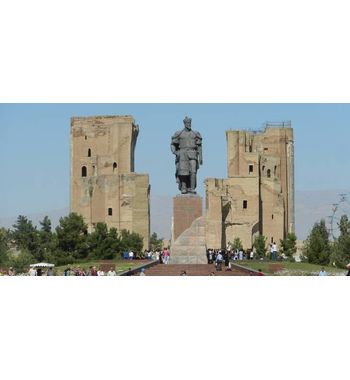
- Ak-Saray Palace. The ruins of Amir Timur's residence. The palace was built in the early 15th century;
- Dorut-Tilavat Ensemble. The complex includes Timurid mausoleums and the Kok-Gumbaz Mosque.
The tour takes about 2 hours. After that continue to Samarkand. Upon arrival check into the hotel and overnight.
Day 9: Samarkand
At the hotel you will be met by a guide and driver. The sightseeing program in Samarkand starts, where you'll see:
- Registan Square. Samarkand's main attraction. Here are three medieval madrasas;
- Bibi-Khanym Mosque. A monumental building erected by Tamerlane for his beloved wife;
- Siab Bazaar. A huge market where vegetables and fruits, flatbreads, oriental sweets and much more are sold;
- Ulugh Beg Observatory. One of the important medieval observatories, built by Tamerlane's grandson;
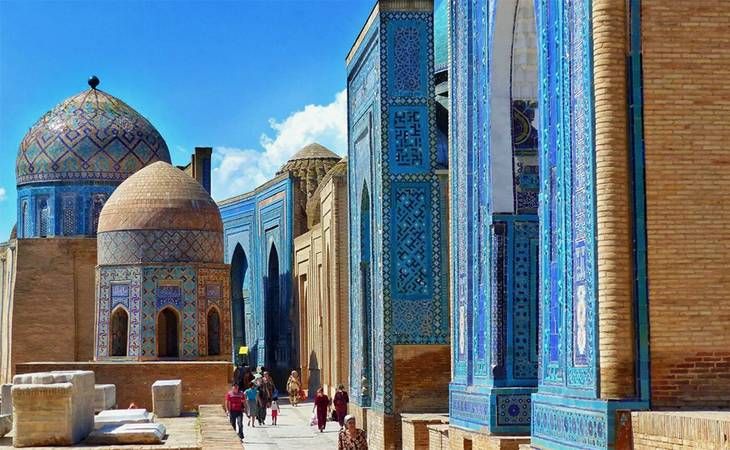
- Shakhi-Zinda complex. A burial place of Samarkand's nobility;
- Gur-Emir Mausoleum. The tomb of Tamerlane, some of his sons and grandsons, and his mentor Mir Said Baraka.
The tour lasts 6-7 hours. Then overnight at the hotel.
Day 10: Samarkand – Tashkent
Breakfast and continuation of exploring Samarkand, where you'll visit:
- Afrasiab Museum. Here you'll learn more about Samarkand's history;
- Khodja Doniyor Mausoleum. The burial place of the prophet Daniel;
- Konigil village. Here is a factory producing paper using ancient technology.
The tour takes about 3-4 hours. Then transfer to the station for the high-speed train to Tashkent (2 hours 10 minutes). Upon arrival you'll be taken to the hotel. Overnight at the hotel.
Day 11: Tashkent
Breakfast and the start of a tour of Uzbekistan's capital. You'll visit the "Old City", home to the religious center Hast Imam. It houses the famous Quran of Caliph Uthman. Then you'll visit one of Tashkent's oldest bazaars – Chorsu ("Eski Juva").
After the "Old City" you'll take the capital's metro for a few stations. Exiting the metro, you'll visit the Applied Arts Museum. Then you'll walk past the Alisher Navoi Academic Theatre to Amir Timur Square.
The tour takes 4-5 hours. Then free time and overnight at the hotel.
Day 12: Tashkent – end of tour
Check out of the hotel by noon. The driver will take you to the international airport at the pre-arranged time. Completion of the "Oasis of the Medieval East" tour.