




Hot tours in Uzbekistan. Gur-Emir Mausoleum in Samarkand
The Gur-Emir mausoleum (Uzbek: Goʻri Amir — "Tomb of the Emir") is a magnificent architectural monument located in Samarkand. It’s the burial place of the great conqueror Amir Timur (Tamerlane), his sons Shah Rukh and Miran Shah, his grandsons Ulugh Beg and Muhammad Sultan, and his spiritual teacher Mir Sayyid Baraka. Construction of the mausoleum began in 1403 after the sudden death of Muhammad Sultan, Timur’s beloved grandson and expected heir. When Amir Timur himself died in 1405, he was also buried here, even though he had originally planned to be buried in Shakhrisabz.
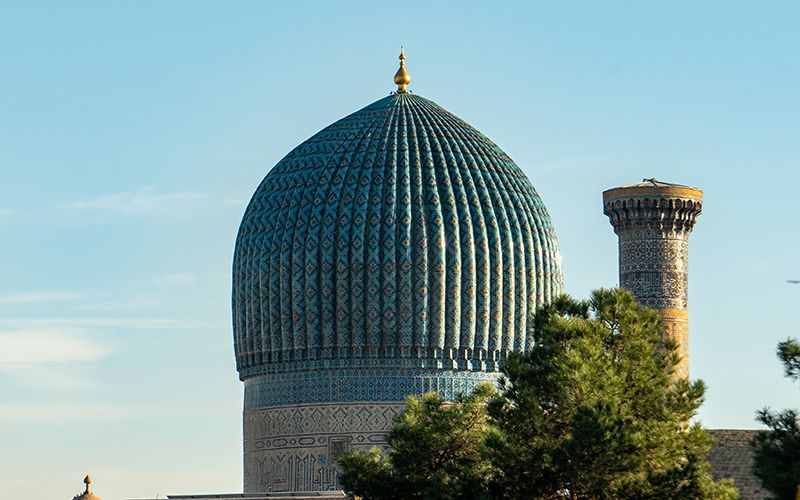
If you decide to buy a tour to Samarkand, I really recommend you visit the Gur–Emir mausoleum. It’s stunning and very well preserved. The wall and ceiling decorations are breathtaking. Its gates look like they belong in a fairy tale. The exterior colours are lovely — sandy walls topped with a blue semicircular roof. Inside the mausoleum it’s equally beautiful. Another reason so many people visit is that Tamerlane, the conqueror of Central Asia, rests here. You can even see the coffin of the famous conqueror: unlike Turkish sultans who were buried differently, coffins here were simply placed in the burial chambers. The coffin appears to be made from a single large piece of marble.

The mausoleum is a single-domed building with adjacent structures, of which only the ruins of a madrasa and a khanaka (a travellers’ hospice) remain today. It stands out for its simple design and solemn monumentality. The walls of the tomb are covered with tiles and nowhere will you find images of people or animals, as that is forbidden by Muslim tradition. So tiles often show flowers or geometric patterns instead. That doesn’t make it less attractive — on the contrary, it gives the place its own unique charm and little twist. The dominant feature is a huge ribbed dome of bright blue with deep rosettes and white flecks. The dome’s diameter is 15 metres and its height is 12.5 metres.
The interior is decorated with large niches that make the space feel even bigger. The lower parts of the walls are covered with onyx slabs, while the upper parts are adorned with decorative panels and murals with star-shaped patterns. The inside of the dome is decorated with skillfully made gilded papier-mâché patterns. In the centre of the hall there are tombstones marking the burial spots. The real graves are in an underground crypt. The central tombstone, made of dark green nephrite, belongs to Amir Timur.

Not far from the Gur–Emir tomb is Amir–Timur Park. I’m not sure if it’s a coincidence, but people often just call Tamerlane "Timur", so maybe that’s why the park is named Amir–Timur. The park deserves a visit too — it’s always clean and tidy, a nice place to rest from wandering the city. From there you get a very pretty view of the Gur–Emir mausoleum; from that angle it looks even lovelier with its neat walls and striking semicircular roof.














