




How to pick the right sleeping bag?
Sleeping bag — one of the most important pieces of kit for any tourist, traveler or outdoor activity lover. The right choice affects your comfort, sleep quality and, most importantly, safety when the weather changes. To avoid mistakes, you need to take several key parameters into account.
The sleeping bag should come with a technical sheet indicating the materials it’s made of: inner fabric, outer fabric, filling, its density and the allowable temperatures for use.
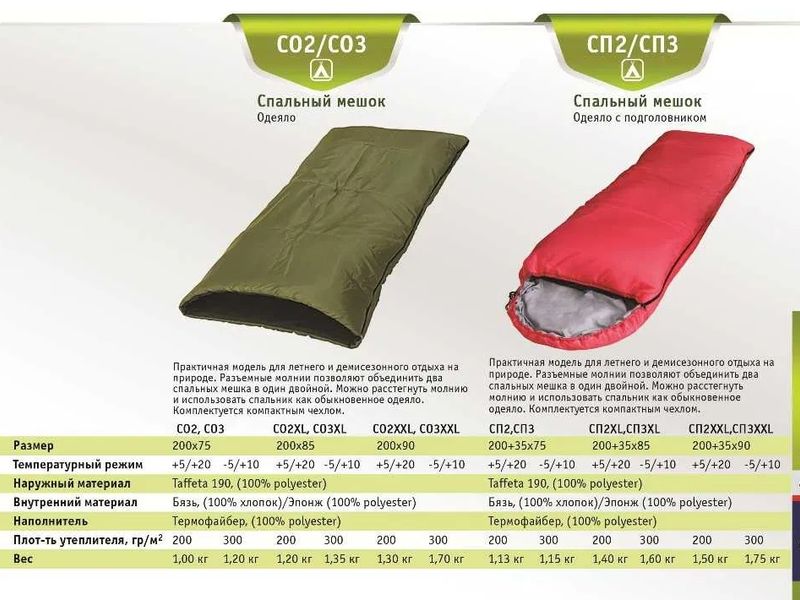
The main criterion when choosing a sleeping bag is its purpose: extreme sleeping bag, sleeping bag for hikes and travels, sleeping bag for camping.
A quality sleeping bag is distinguished by:
- no “cold” seams — those stitched all the way through;
- a reinforced strip preventing fabric from getting into the zipper;
- a drawstring with a lock on the hood of the sleeping bag;
- a special loop for drying the sleeping bag;
- neat, straight stitches without visible manufacturing defects on the fabric;
- good-quality hardware.
Sleeping bags come in a variety of constructions:

- Sleeping bag - blanket. A simple blanket with a long separating zipper. As an extra option — the ability to zip sleeping bags together (right sleeping bag and left sleeping bag).

- Sleeping bag - blanket with a headrest. The same blanket but with a headrest for extra comfort.

- Sleeping bag - cocoon. A model tapered toward the bottom and wider at the top with a hood and a footbox. The most comfortable model, allowing you to retain heat inside the bag as much as possible thanks to its shape.
Temperature ratings (the most important parameter)
On every sleeping bag that meets international standards (for example, EN 13537) three main temperature characteristics are indicated:
- T° Comfort — the minimum temperature at which an “average” woman can sleep comfortably all night in a relaxed position. For most travelers this is the most important indicator to focus on.
- T° Limit — the lower comfort limit / limit temperature — the minimum temperature at which an “average” man can sleep in a zipped sleeping bag in a curled-up position without feeling severe cold, though sleep won’t be fully comfortable.
- T° Extreme — the minimum temperature at which an “average” woman can remain in the sleeping bag for 6 hours without life-threatening risk, but with the risk of hypothermia. This is a survival temperature, not a comfortable sleep temperature. Using a bag at this temperature is strongly discouraged.
- T° Maximum — the highest temperature at which an adult man can sleep in an unzipped bag without excessive sweating.
Type of insulation
The insulation determines thermal properties, weight, volume and price of the sleeping bag.
- Down (Down):
- Pros. Best heat-to-weight-and-volume ratio. Very light and compact when packed. Ideal for cold conditions and long hikes where every gram counts.
- Cons. Expensive. Loses insulating properties when wet and takes a long time to dry. Requires special care and storage. Can cause allergies.
- Fill Power (FP). The higher the FP (for example, 600, 750, 850+), the better the quality of the down, its ability to loft and, accordingly, its insulation.
- Synthetic (Synthetic):
- Pros. Cheaper than down. Retains insulating properties even when damp. Dries quickly. Hypoallergenic. Easy to care for.
- Cons. Heavier and bulkier than down bags for the same comfort temperature. Over time the insulation may compress and lose performance.
- Types. There are many synthetic insulators (Hollowfiber, Thinsulate, Primaloft, Polarguard and others) that differ in quality and characteristics.
Tip. For wet conditions or budget hikes choose synthetic. For high-altitude climbs and winter hikes where every gram matters, down is the best choice if you’re ready for its quirks.
The right sleeping bag will give you a full rest and energy for new adventures in nature.











